Two Neural Dynamics Researchers Named to the Laurel and Scroll 100
Nihar Sanda and Daniela Gonzalez join Northeastern’s 2026 class of top graduate students, honored for research impact spanning knowledge aggregation in biomedicine and deep learning for precision oncology.


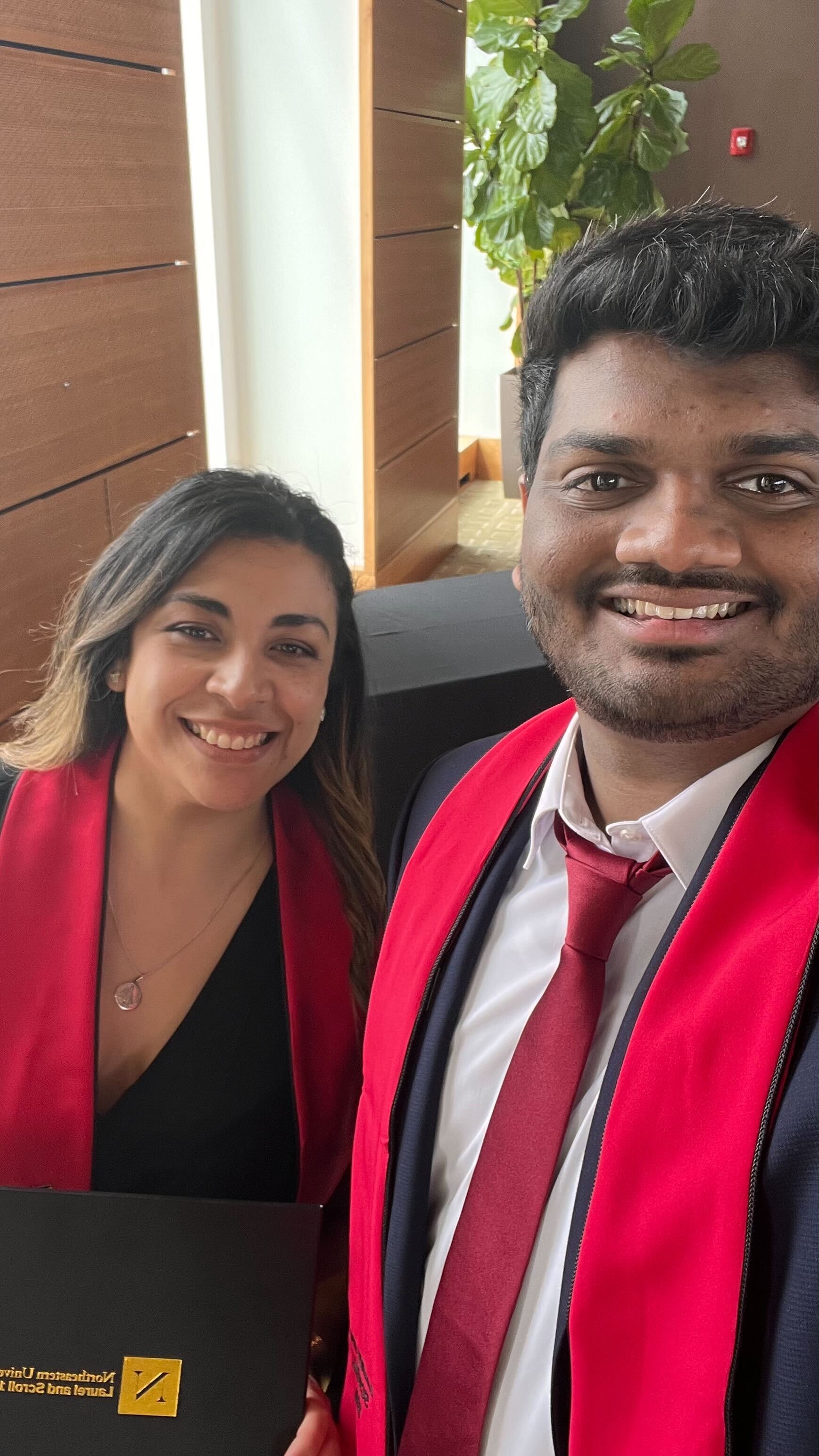
On April 15, 2026, Northeastern University inducted its 2026 Laurel and Scroll 100, a century-old honor recognizing the university’s most exceptional graduate students. Two members of the Neural Dynamics Group, Nihar Sanda and Daniela Gonzalez, were named to this year’s class for their outstanding research contributions and scholarly impact.
The Laurel and Scroll 100 is awarded to graduate students whose academic excellence, research achievements, leadership, and service distinguish them among their peers. Inductees represent the full breadth of Northeastern’s graduate community, ranging from artists and entrepreneurs to engineers and scientists. For a small research group, having two members recognized in the same year speaks directly to the caliber of research and mentorship that defines Neural Dynamics.
In this post, we look closely at their work: the problems they are tackling, the methods they are inventing, and the communities their research is already reaching.
Nihar Sanda: Architecting Intelligence for Biomedicine
Nihar joined the Neural Dynamics Group as a Research Associate after completing his M.S. in Computer Science at Northeastern’s Khoury College of Computer Sciences. He holds a B.Tech in Computer Science and Engineering from IIIT Dharwad, where he graduated with the Director’s Gold Medal for Best Outgoing Student. He is a two-time Google Summer of Code recipient and an open-source contributor to projects at CERN (Rucio) and the biospheric-modeling project PEcAn.
At Neural Dynamics, Nihar leads the development of PRISM (Precision Research and Information Systems for bioMedicine), a unified AI-augmented knowledge aggregation platform for life sciences. PRISM integrates Neo4j knowledge graphs, FastAPI backends, and multi-agent retrieval-augmented generation (RAG) systems to let researchers ask complex, cross-domain biomedical questions and get back synthesized, source-grounded answers.
He is the lead author of eGoT (enhanced Graph-of-Thoughts), a novel graph-based reasoning algorithm that combines iterative reasoning with knowledge graph traversal. eGoT achieves state-of-the-art performance on multi-hop question-answering benchmarks including MultiHopRAG and HotpotQA, outperforming strong baselines such as HopRAG, SireRAG, HiRAG, and HippoRAG. The work has been accepted at ISMB 2026, one of the flagship venues in computational biology.
Beyond PRISM and eGoT, Nihar’s engineering work spans Cypher query-generation pipelines, knowledge graph construction workflows leveraging GPT-4 and DeepSeek-V3, and advanced embedding systems processing biomedical and climate-science literature. His research interests sit at the intersection of knowledge aggregation, agentic AI, and AI safety. This combination has already led to partnerships with five major medical institutions.
Nihar is now continuing this work as a Machine Learning Engineer at the Institute for Experiential AI, where he is commercializing the knowledge aggregation platform and building next-generation scientific discovery engines for the life sciences. Earlier this year, he also received the 2026 Graduate Research Award from Khoury College.
Daniela Gonzalez: Bridging the Bench and the Model
Daniela joined Neural Dynamics as a Graduate Research Associate while completing her M.S. in Data Science at Northeastern. She brings an unusual, and unusually powerful, profile to the group: over ten years of research experience spanning wet-lab biology, computational modeling, and data science. She holds a Ph.D. in Biological Sciences and a B.S. in Biotechnology from Universidad Nacional de Tucumán, and before joining Northeastern she developed machine-learning pipelines for biologics in the pharmaceutical industry, with hands-on experience in molecular docking, QSAR modeling, and cancer cell line assays.
Her current research at Neural Dynamics focuses on deep learning for drug combination synergy prediction, a problem with enormous clinical relevance. Treating complex diseases like cancer almost always requires combinations of drugs, yet the combinatorial space is vast, preclinical screens are expensive, and most existing models stop at prediction without closing the loop to experimental validation.
Daniela is extending deep-learning architectures to predict not just synergy but also therapeutic windows for personalized cancer treatment, integrating tumor transcriptomics with rich molecular drug representations. What distinguishes her work is an insistence that computational predictions be grounded in biological and clinical reality: she designs models with an eye to how their outputs will be validated in the lab and, eventually, interpreted at the patient level.
She has authored over ten peer-reviewed publications spanning early drug discovery, computational biology, and data science. Her long-term goal is to strengthen the bridge between computational prediction and experimental validation in precision oncology, working toward a future where in silico models reliably inform therapeutic decisions for real patients.
Her contributions have already been recognized beyond the Laurel and Scroll 100: Daniela has been selected as the Commencement Speaker for Khoury College’s 2026 graduation ceremony, where she will share her perspective on working across experimental and computational science with the graduating class and their families.
A Shared Ethos
Nihar and Daniela work on very different problems (knowledge aggregation at scale versus drug combination prediction for cancer), yet their research shares a common thread: a refusal to treat machine learning as an end in itself. Both are building systems that translate cutting-edge methods into tools that clinicians, biologists, and researchers can actually use. Both ground their algorithms in domain reality. And both exemplify the kind of researcher Neural Dynamics aims to train: technically deep, scientifically grounded, and unafraid to work across disciplines.
Congratulations to Nihar and Daniela on this well-earned honor. We are proud to have them as part of the group, and excited to see where their work goes next.